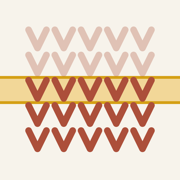
"Decrease every 6th row 8 times": how to read it
Photo: Yuliia Pakhomova / Unsplash
"Decrease every 6th row 8 times" means: work 5 rows without shaping, decrease on the 6th, and do that 8 times. The decreases fall on rows 6, 12, 18, 24, 30, 36, 42 and 48 of the shaping section, so it takes 48 rows. With a decrease at each end (2 stitches per decrease row) you lose 16 stitches: 72 becomes 56.
What "every Nth row X times" means
Shaping instructions for sleeves, waists and tapered pieces come in two parts: how often (every 6th row) and how many times (8 times). Read them like this:
- Every 6th row: count the row after the instruction as row 1. Rows 1 to 5 are worked as set; row 6 is a shaping row. Then start counting again: 5 plain rows, a shaping row.
- 8 times: the number of shaping rows, not the number of stitches. If each shaping row decreases at both ends, 8 shaping rows remove 16 stitches.
- Every other row (or "every alternate row", "every alt row"): every 2nd row. The Craft Yarn Council's abbreviation list and Vogue Knitting's glossary both give "alt" as alternate.
- Every row: no plain rows in between.
The total length of the shaping section is the interval times the number of shapings: 6 × 8 = 48 rows. Most patterns then tell you to work even (no shaping) until the piece measures a certain length.
The stitch count, row by row
Here's a sleeve knitted in the round from the top down: 72 stitches, "decrease 2 stitches every 6th round 8 times". Only the decrease rounds change the count, so those are the rows worth writing down.
| Decrease | Round of the shaping section | Stitches after it |
|---|---|---|
| 1 | 6 | 70 |
| 2 | 12 | 68 |
| 3 | 18 | 66 |
| 4 | 24 | 64 |
| 5 | 30 | 62 |
| 6 | 36 | 60 |
| 7 | 42 | 58 |
| 8 | 48 | 56 |
Two quick checks catch most mistakes. The round number of each decrease is the interval times the decrease number (decrease 5 is on round 6 × 5 = 30). And the stitches after any decrease are the starting count minus 2 for each decrease so far (after decrease 5: 72 − 10 = 62). If your stitch count and your row count disagree with the table, one of them is off, and it's easier to find now than at the cuff. Our free shaping planner prints this table for any start count, interval and number of times.
Where the decreases go
A sleeve or side decrease is usually worked at both edges, a stitch or two in from the edge:
- Flat: the classic layout is k1, k2tog (or ssk), knit to the last 3 stitches, decrease, k1. Kate Atherley's Wiseknit column in Knitty walks through this layout for decreasing at both ends of a row, and explains that keeping the decrease a stitch or two in from the edge keeps it visible after seaming and makes finishing easier.
- In the round: the "edges" are either side of a marker, usually at the underarm. A common layout is k1, k2tog, knit to the last 3 stitches before the marker, ssk, k1.
Tin Can Knits notes that top-down sleeve decreases are usually spaced every 5th to 8th row, wider apart than raglan or shawl shaping, so the line they make is gentle. Whatever layout you choose, use the same one on every decrease row so the shaping lines up.
"On the next and every following 6th row"
Many patterns, especially British ones, write the instruction differently: "decrease 1 st at each end of the next and every following 6th row". Simply Yarn's sleeve example is written this way, with its increases on the next and every following 10th row until a given stitch count is reached. The wording changes where the first shaping row goes:
| Wording | Shaping rows |
|---|---|
| Every 6th row | 6, 12, 18, 24, … |
| Next and every following 6th row | 1, 7, 13, 19, … |
The count can also differ. "Next and every following 6th row 7 times" can mean 8 shaping rows in all (the first one plus 7 more, ending on row 43) or 7 in all. Patterns usually settle it by telling you how many stitches you should have at the end. Always work back from that number: stitches to lose ÷ stitches per shaping row = shaping rows. 16 stitches at 2 per row is 8 rows.
"Every 4th and 6th row alternately"
When the shaping needs to happen at a rate between two whole numbers, patterns alternate two intervals. "Increase 1 stitch at each end of every 4th and 6th row alternately" means the gaps take turns: 4 rows, then 6, then 4, then 6.
Example: 60 stitches, increase 1 st at each end of every 4th and 6th row alternately, 6 times.
Shaping rows: 4, 10, 14, 20, 24, 30.
Stitches after each: 62, 64, 66, 68, 70, 72.
Two shaping rows every 10 rows; six of them take 30 rows.
Here too, "6 times" might mean six shaping rows or six pairs of intervals, depending on the designer. The finished stitch count in the pattern decides it. Simply Yarn's guide to adjusting set-in sleeves shows a related form: one interval for a while, then a second one (every 10th row, then every 12th row). Read that as two separate sections, one after the other.
Which side the shaping rows land on
In the round every round is a right-side round, so this doesn't come up. Worked flat, it does:
- Even intervals (every 2nd, 4th, 6th, 8th row): every shaping row lands on the same side. If the first one is a right-side row, they all are.
- Odd intervals (every 3rd, 5th, 7th row): shaping rows alternate between the right side and the wrong side, so you'll need a wrong-side decrease such as p2tog every other time.
If your pattern says to shape on right-side rows only and your count puts a decrease on a wrong-side row, the count is off by one somewhere, usually because the set-up row was counted as row 1.
Working out your own numbers
If you change a sleeve's length or width, you'll need a new interval. The arithmetic is short:
- Stitches to lose: start count minus end count. 72 − 56 = 16.
- Shaping rows: stitches to lose ÷ stitches per shaping row. 16 ÷ 2 = 8.
- Rows available for the shaping, from your row gauge and the length. Say 50 rounds.
- Interval: rows available ÷ shaping rows. 50 ÷ 8 = 6.25, so every 6th round 8 times (48 rounds), and 2 rounds even before the cuff.
When the interval comes out near a half, mix two intervals. 9 shaping rows over 60 rounds is 6.67 per shaping: every 6th round 3 times, then every 7th round 6 times, uses exactly 18 + 42 = 60 rounds. Simply Yarn's sleeve guide does the same kind of calculation from gauge, and ends with a mixed plan of the same kind: a decrease at each end of every fourth row 7 times, then every alternate row 13 times. The shaping planner shows the stitch count after every row once you've chosen the interval.
Keeping track without a tally
Shaping instructions often run at the same time as something else: a stitch pattern, a stripe sequence, a cable repeat. That's two counts at once, the row within the repeat and the rows since the last decrease, and it's where tally marks go wrong.
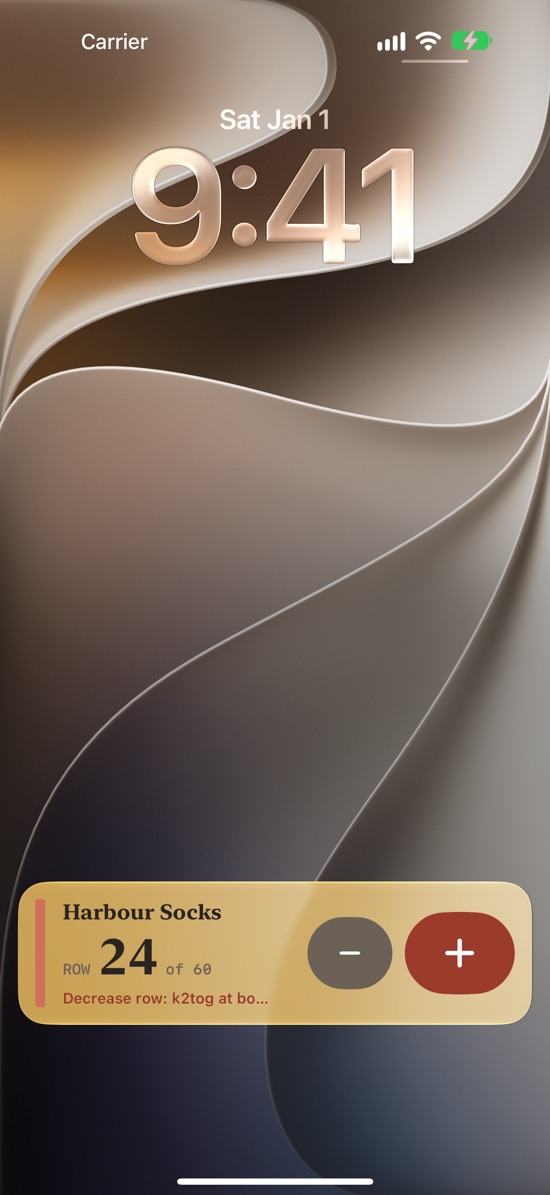
Ballband has a Shaping counter for exactly this. You give it the stitches you have now, the change (−2), how often (every 6 rows) and how many times (8). It moves with your row counter from the row you add it on, tells you on each shaping row, and keeps the stitch count as you go; undo puts the count back exactly. For alternating intervals like "every 4th and 6th row", two row notes do the job: one on row 4 that repeats every 10 rows, and one on row 10 that repeats every 10 rows. Each note appears on its row, on the counter screen and on the Lock Screen.
Questions
Does "every 6th row" start counting from the row I'm on?
It starts from the row after the instruction: that's row 1, and the first shaping happens on row 6. If the pattern says "the next and every following 6th row", the first shaping is on the very next row instead.
Is "every other row" the same as "every 2nd row"?
Yes. "Every other row", "every alternate row" and "every alt row" all mean shape on one row, work the next row plain, and repeat.
Do wrong-side rows count?
Yes. In flat knitting every row counts, right side and wrong side. "Every 6th row" means six rows of knitting, which is three right-side rows and three wrong-side rows.
What if I lose count halfway through a sleeve?
Count the stitches. Subtract from the starting count and divide by the stitches per shaping row: that tells you how many shaping rows are done. Then count rows up from the last decrease, which is easy to spot in the fabric.
For a decrease row spread evenly across one row instead of over many rows, see how to decrease evenly across a row.
- Craft Yarn Council: Knitting Abbreviations Master List (alt, dec, inc, RS, WS), checked 22 Nov 2026.
- Vogue Knitting: Terms & Abbreviations (alt = alternate, alternately), checked 22 Nov 2026.
- Knitty, Wiseknit: Fully Fashioned Shaping: Decreases (Kate Atherley, Spring + Summer 2025), checked 22 Nov 2026.
- Tin Can Knits: Decrease Lines (Emily Wessel, 25 July 2024), checked 22 Nov 2026.
- Simply Yarn: How to adjust the length of set-in sleeves (Jen Arnall-Culliford), checked 22 Nov 2026.