How to read a knitting chart, with a worked example
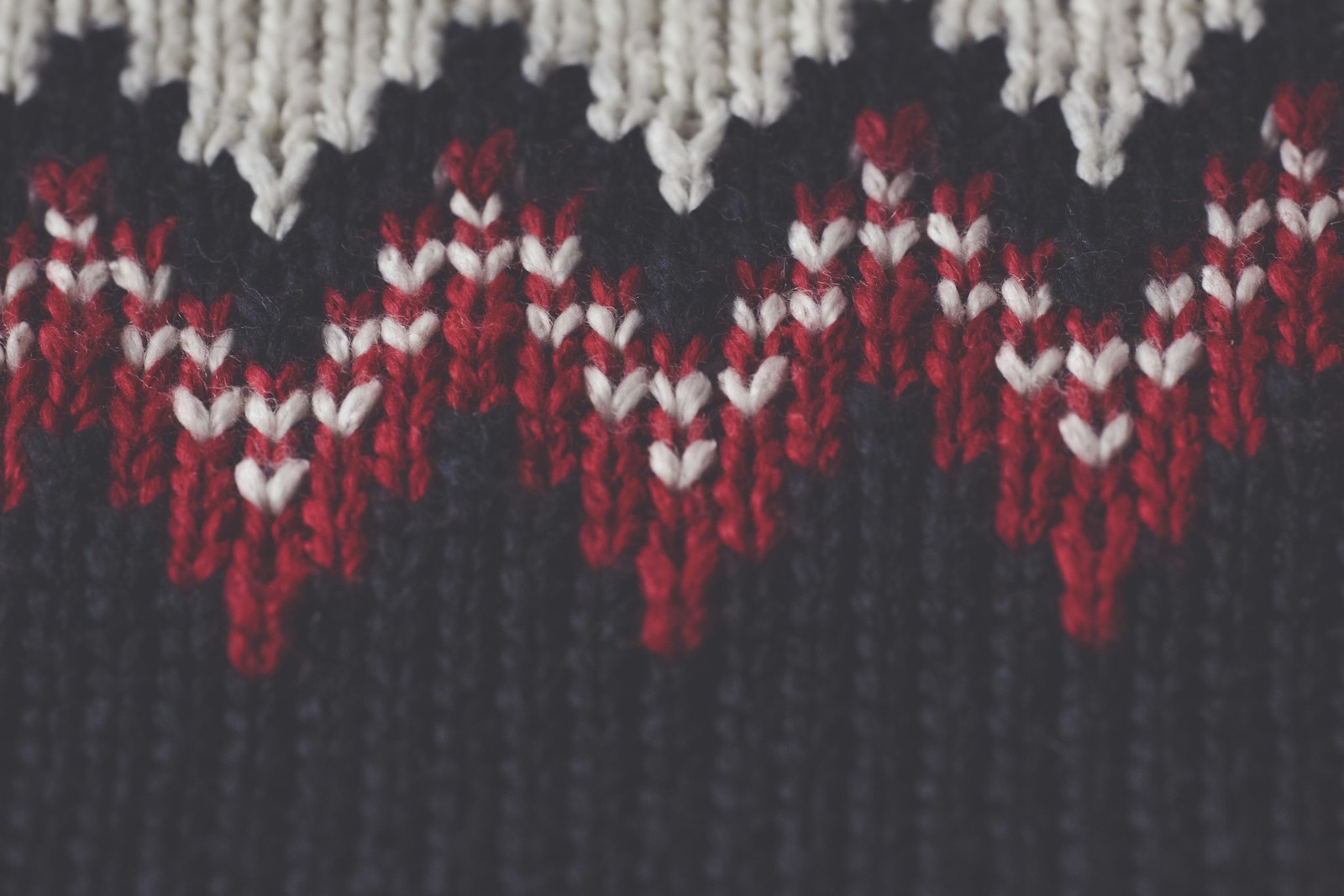
Photo: Markus Spiske / Unsplash
A knitting chart is a grid: each square is one stitch, each row of squares is one row (or round). Start at the bottom right. Read right-side rows from right to left and wrong-side rows from left to right; in the round, read every round from right to left. The key tells you what each symbol means.
What a chart is
A chart draws the pattern the way the fabric will look from the front, the right side. One square, one stitch. One row of squares, one row of knitting. Because you knit upward from the cast-on, the chart grows upward too: Row 1 is at the bottom, and the first stitch of Row 1 is in the bottom right corner.
That's why charts feel strange at first and then become faster than written instructions. Instead of reading "k1, k2tog, yo, k1" you see the yarn over sitting above the stitch it lines up with in your fabric, and you can check your work against the picture.
Which way do you read a knitting chart?
- From the bottom up. Row 1 at the bottom, then one row higher for every row you work.
- Right-side rows: right to left. With the right side facing you, the first stitch you work is at the right-hand end of the fabric, and you work toward the left.
- Wrong-side rows: left to right. When you turn the work, the stitch that was last on the right side is now the first one you work. A printed chart can't be turned over, so you read the row in the other direction instead.
- In the round: always right to left. You never turn, so every round is a right-side round.
Row numbers tell you the direction
Most charts put each row's number on the side where that row starts. On a flat chart the odd-numbered rows (usually the right-side rows) are numbered on the right edge and the even-numbered rows on the left edge. If all the numbers sit on the right, the chart was drawn for knitting in the round.
Some charts show only the right-side rows, numbered 1, 3, 5, 7. The wrong-side rows are left out because they're plain, and the pattern tells you what to do on them, often "purl all stitches" or "knit the knits and purl the purls". If the numbers skip, don't skip the rows: work a wrong-side row between every two chart rows.
Symbols and the key
Each symbol shows how the stitch looks from the right side. That's the detail that trips people up on wrong-side rows: a blank square is a knit stitch on the right side, so on a wrong-side row you purl it, because a purl from the back is a knit from the front. The Craft Yarn Council's chart symbol list pairs them up the same way.
| Symbol (common form) | On a right-side row | On a wrong-side row |
|---|---|---|
| Blank square | Knit | Purl |
| Dot | Purl | Knit |
| Circle (O) | Yarn over | Yarn over |
| Slash leaning right (/) | K2tog (right-leaning decrease) | P2tog |
| Slash leaning left (\) | Ssk (left-leaning decrease) | Ssp |
| Grey or black square | No stitch: skip the square and go to the next one | |
Symbols vary between designers and publishers, so read the key before you knit a stitch, especially for cables and for any symbol that covers more than one square. Some keys give one meaning for right-side rows and another for wrong-side rows; Brooklyn Tweed's chart tutorial calls these "chameleon" symbols. If a symbol isn't in the key, look in the pattern's abbreviations or special stitches section before you guess.
The "no stitch" squares appear where a decrease has taken stitches away and the chart still needs to stay rectangular. They're placeholders. You don't work anything there; you go to the next real square on the same row.
Repeat boxes
A chart rarely shows the whole width of a piece. It shows one repeat, outlined with a heavy or colored box (or marked with brackets), plus any edge stitches outside it. You work the stitches before the box once, the boxed stitches as many times as the pattern says or as fit, and the stitches after the box once. The pattern's notes tell you how many repeats to work; a cast-on count of edge stitches plus a multiple of the repeat width is a strong hint.
Repeats can be vertical too: the pattern may say "work Rows 1–8 of the chart 5 times". That's where a second counter that counts 1 to 8 and then starts over saves a lot of mental arithmetic.
A worked example
Here is a small chart, 6 stitches wide and 6 rows high, worked flat. The red box marks a 4-stitch repeat; the stitch on each side of it is an edge stitch, worked once.
Cast on 14 stitches: 1 edge stitch + 3 repeats of 4 + 1 edge stitch = 1 + 12 + 1 = 14.
Read Row 1 starting at the bottom right square, stitch 1. Read Row 2 starting at the left, stitch 6. Inside the box, work the four squares as many times as the pattern says: here, 3 times.
| Row | Side | Read | Written out (14 sts) |
|---|---|---|---|
| 1 | RS | Right to left | k1, [p4] 3 times, k1 |
| 2 | WS | Left to right | purl all 14 |
| 3 | RS | Right to left | k1, [k1, k2tog, yo, k1] 3 times, k1 |
| 4 | WS | Left to right | purl all 14 |
| 5 | RS | Right to left | k1, [k1, yo, ssk, k1] 3 times, k1 |
| 6 | WS | Left to right | p1, [k4] 3 times, p1 |
Three things to notice:
- Row 2 and Row 4 are blank, and you purl them. Blank means knit as seen from the right side; on a wrong-side row that's a purl.
- Row 6 has dots, and you knit them. A dot is a purl on the right side, so from the wrong side you knit. The result on the front is a purl ridge, the same as the dots in Row 1.
- The stitch count stays at 14. In Rows 3 and 5 each repeat has one decrease (k2tog or ssk, two stitches into one) and one yarn over (one new stitch), so they balance. If your count drifts, the usual cause is a forgotten yarn over.
Writing a chart out like this once, for the first repeat, is a good way to learn a new chart. After a few rows you'll find you read the symbols directly.
Reading a chart in the round
In the round, every round is worked with the right side facing you, so every round of the chart is read from right to left, and the numbers usually all sit on the right edge. The chart itself doesn't change between flat and circular knitting. What changes is how you read the symbols: a blank square is always a knit and a dot is always a purl, because there are no wrong-side rows.
If you're working a flat chart in the round (or the other way round), redraw or re-key the even rows before you start, so you don't have to translate on every row.
Keeping your place in a chart
- Cover the rows above the one you're on with highlighter tape or a sticky note, so the worked rows below stay visible and you can compare them with the fabric.
- Number the columns inside a wide repeat, and put a stitch marker between repeats on your needle. When a repeat ends with the wrong stitch, the mistake is within those few stitches.
- Enlarge the chart. A photocopy at a bigger size, or a zoomed-in PDF, makes it much harder to read the row above by accident.
- Count chart rows and pattern repeats separately. "Row 3 of the chart, third time through" is two numbers; keep both written down.
If you follow charts on a phone or tablet, Ballband can do the covering for you: you drag a box around the chart, it reads the row numbers at the chart's edge when there are any, and the line steps through the chart (Row 1 at the bottom or at the top) every time you count, starting over after the last row. For patterns written row by row there's also the free pattern follower on this site.
Questions
Do you read a knitting chart from left to right or right to left?
Right-side rows from right to left, wrong-side rows from left to right. In the round every round is read from right to left.
Where do I start on a knitting chart?
At the bottom right corner: the first stitch of Row 1. Unless the pattern says Row 1 is a wrong-side row, in which case Row 1 starts on the left.
Why is the wrong-side row blank but I'm supposed to purl?
Chart symbols show how the stitch looks from the right side. A blank square is a knit on the right side, which you make by purling when the wrong side faces you.
What does the black or grey square mean?
Usually "no stitch": a placeholder where stitches have been decreased away. Skip it and work the next square. Check the key; some designers use grey for purl.
What does the red box on a knitting chart mean?
It marks the repeat: the stitches you work again and again across the row. Stitches outside the box are worked once, at the start or end of the row.
- Craft Yarn Council: Knit Chart Symbols (symbols show the stitch from the right side; knit on RS is purl on WS, k2tog is p2tog, ssk is ssp), checked 22 Nov 2026.
- Craft Yarn Council: Knitting Abbreviations Master List (k2tog, ssk, yo, RS, WS), checked 22 Nov 2026.
- Brooklyn Tweed: Reading Charts (bottom up, RS right to left, rounds right to left, repeat boxes, no-stitch squares, the legend), checked 22 Nov 2026.
- Yarnspirations: Guide to Reading Knitting Stitch Charts (odd rows numbered on the right, even on the left; all numbers on the right in the round), checked 22 Nov 2026.
- LoveCrafts: How to read a knitting chart (first stitch at the bottom right; alternate rows may be left out; the key can change in the round), checked 22 Nov 2026.